
The Ultimate 2026 Study Routine for NEET Droppers: How to Build Unbreakable Focus
- SOHAN TAMANG
- 3 days ago
- 7 min read

Summarize this blog post with: ChatGPT | Perplexity | Claude | Grok
You already know the syllabus is not the real problem.
Most NEET droppers fail because their attention collapses long before their preparation does. Endless distractions, inconsistent routines, burnout cycles, and app overload silently destroy momentum. This guide will show you how to build a sustainable 2026 study routine that creates deep focus, protects mental energy, and helps you study like rankers do.
Key Takeaways
Focus endurance matters more than raw study hours for NEET droppers. Structured Pomodoro sessions improve concentration and reduce mental fatigue. Fixed daily study blocks outperform random marathon sessions. Distraction-free environments directly increase retention and revision quality. Sleep consistency has a measurable impact on memory consolidation and recall speed. Active revision systems are more effective than passive rereading. Minimal productivity systems reduce burnout and prevent “study planning addiction.”
What Is a Study Routine for NEET 2026 Droppers?
A study routine for NEET droppers is a structured daily system designed to maximize focus, retention, revision consistency, and exam performance during a dedicated preparation year.
Unlike school-going aspirants, droppers have complete schedule freedom. That freedom becomes dangerous without structure. Many students start strong in June and mentally crash by October because they rely on motivation instead of systems.
A proper NEET dropper routine is not about studying 16 hours daily. It is about creating repeatable deep-work cycles that protect concentration for 8–12 months consistently.
According to cognitive performance research, consistent focused sessions outperform irregular high-intensity cramming for long-term retention — Source: American Psychological Association, 2025.
Why Study Routines Matter for NEET Droppers
A study routine matters for NEET droppers because predictable structure reduces decision fatigue and preserves mental energy for learning.
Every unnecessary decision drains cognitive bandwidth. Choosing when to study, what to revise, or which app to open creates micro-fatigue throughout the day. Students often mistake this exhaustion for “lack of motivation.”
For example, a NEET dropper studying Biology at 7 AM daily builds automatic behavioral momentum. A student studying “whenever they feel like it” wastes energy negotiating with themselves constantly.
Here are some important numbers:
Study Factor | Performance Impact |
Consistent sleep schedule | Up to 20% better memory recall |
Pomodoro-based deep work | Higher sustained attention spans |
Reduced phone interruptions | Faster concept retention |
Active recall revision | Better long-term memory retention |
Research from Stanford University found that multitasking reduces productivity and cognitive performance significantly compared to focused single-task work — Source: Stanford Research Institute, 2025.
This is why rankers protect focus aggressively.
What Is the Best Daily Study Routine for NEET Droppers in 2026?
The best daily study routine for NEET droppers in 2026 is a structured system built around deep work, PYQ practice, mock-test conditioning, revision cycles, and recovery periods.
The goal is not maximum study hours. The goal is maximum high-quality cognitive output sustained consistently for 10–12 months.
Morning Deep Work Block (5:30 AM – 9:00 AM)
Morning hours usually provide the highest concentration quality.
Use this session for:
Physics numerical solving
Organic Chemistry mechanisms
NCERT Biology memorization
Difficult conceptual chapters
Avoid starting the day with passive lecture consumption.
A focused morning session builds momentum for the rest of the day. Many NEET rankers finish their hardest topics before noon because decision fatigue is lowest early in the morning.
Midday Revision + PYQ Session (10:00 AM – 1:00 PM)
Midday study blocks should focus on reinforcement and exam-oriented application.
Use this period for:
Previous Year Question (PYQ) practice
Active recall revision
Formula revision
Error notebook review
NCERT-based MCQs
PYQs are not optional for NEET droppers. They train pattern recognition and reveal how concepts repeatedly appear in the actual exam.
For example, repeated Human Physiology PYQs quickly expose recurring conceptual traps around hormones, nephron function, and cardiac cycles.
Research on retrieval practice consistently shows that active testing improves retention more effectively than passive rereading — Source: Journal of Educational Psychology, 2024.
Mock Test Practice Block (2:00 PM – 5:00 PM)
The 2 PM to 5 PM slot should be reserved for full-length mock tests or intensive question practice because NEET itself is conducted during afternoon hours.
Training your brain during the actual exam window improves:
Cognitive endurance
Attention stability
Time management
Stress adaptation
This is one of the most overlooked strategies among average aspirants.
Use this block for:
Full mock papers
Sectional mock tests
Timed MCQ drills
OMR sheet practice
High-volume question solving
A student practicing under real exam timing develops stronger psychological familiarity with pressure conditions.
Evening Recovery Block (5:30 PM – 7:00 PM)
Evening recovery periods prevent mental burnout and improve long-term consistency.
Use this time for:
Walking
Exercise
Light revision
Meals
Short breaks
Meditation or decompression
Burned-out students cannot sustain competitive preparation.
Recovery is part of the study system, not a reward for studying.
Night Mock Analysis Session (7:30 PM – 9:30 PM)
The night analysis session is where real improvement happens.
Most students take mock tests but never properly analyze them. That is why scores stagnate.
Spend at least 2 hours reviewing:
Wrong answers
Guesswork errors
Time-consuming sections
Weak concepts
Silly mistakes
Chapter-wise accuracy patterns
Mock analysis transforms mistakes into score improvements.
For example:A student repeatedly losing marks in Electrostatics due to sign convention errors should isolate and revise that exact mistake pattern immediately.
Top rankers often spend almost as much time analyzing tests as taking them.
Late Night Light Revision (9:30 PM – 10:15 PM)
The final session should remain low intensity.
Use this time for:
NCERT Biology rereading
Formula recall
Flashcards
Quick revision notes
Avoid highly stressful studying before sleep.
Sleep quality directly impacts memory consolidation and next-day recall performance.
How Can NEET Droppers Build Unbreakable Focus?
Unbreakable focus is the ability to sustain concentrated cognitive effort without constant distraction switching.
Most students do not lack intelligence. They lack attentional stability.
Remove App Switching Completely
Every app switch creates attention residue.
For example:
WhatsApp → YouTube → Telegram → Notes → Chrome
Brain energy gets fragmented repeatedly.
This is why “productive procrastination” feels exhausting.
A distraction-free workspace dramatically improves deep work quality.
Use Pomodoro Sessions Properly
The Pomodoro technique is a time-blocking system using focused work intervals separated by short breaks.
The mistake most students make is using weak Pomodoro cycles like:
25 minutes study
15 minutes scrolling Instagram
That destroys momentum.
A better NEET dropper Pomodoro structure is:
50 minutes deep work
10 minutes recovery
4 cycles
40-minute long break
This creates sustained concentration without burnout.
Protect Dopamine Levels
Dopamine overstimulation destroys attention endurance.
Short-form content consumption trains the brain to expect constant novelty. NEET preparation requires the opposite: delayed reward tolerance.
Students who binge reels before study sessions often struggle to maintain concentration for even 20 minutes.
Replace:
Doomscrolling
Random notifications
Constant music switching
With:
Silent study blocks
White noise
Fixed breaks
Offline revision
What Are the Biggest Mistakes NEET Droppers Make?
The biggest mistakes NEET droppers make are inconsistency, overplanning, burnout schedules, and passive studying.
Studying 14–16 Hours Unrealistically
Extreme schedules work temporarily.
They collapse psychologically after a few weeks.
A sustainable 8–10 hour focused routine beats chaotic 15-hour days consistently.
Consuming Too Many Resources
Many droppers collect:
7 teacher modules
4 coaching apps
20 Telegram channels
Endless PDFs
This creates cognitive overload.
Top performers usually repeat fewer high-quality resources multiple times.
Ignoring Sleep
Sleep is not “wasted study time.”
Memory consolidation occurs during sleep cycles. Students sacrificing sleep for late-night study often reduce recall efficiency the next day.
According to the Sleep Foundation, consistent 7–9 hour sleep improves cognitive processing and memory performance — Source: Sleep Foundation, 2025.
Which Tools Help NEET Droppers Stay Focused?
The best tools for NEET droppers reduce distractions, simplify workflows, and support deep work consistency.
Why Most Productivity Apps Fail Students
Most apps create additional mental clutter.
Students jump between:
Notes apps
Timers
To-do lists
Habit trackers
Calendar tools
This creates “productivity fatigue.”
Google’s guidance for modern search experiences repeatedly emphasizes reducing unnecessary complexity and prioritizing genuinely useful systems.
The same principle applies to studying.
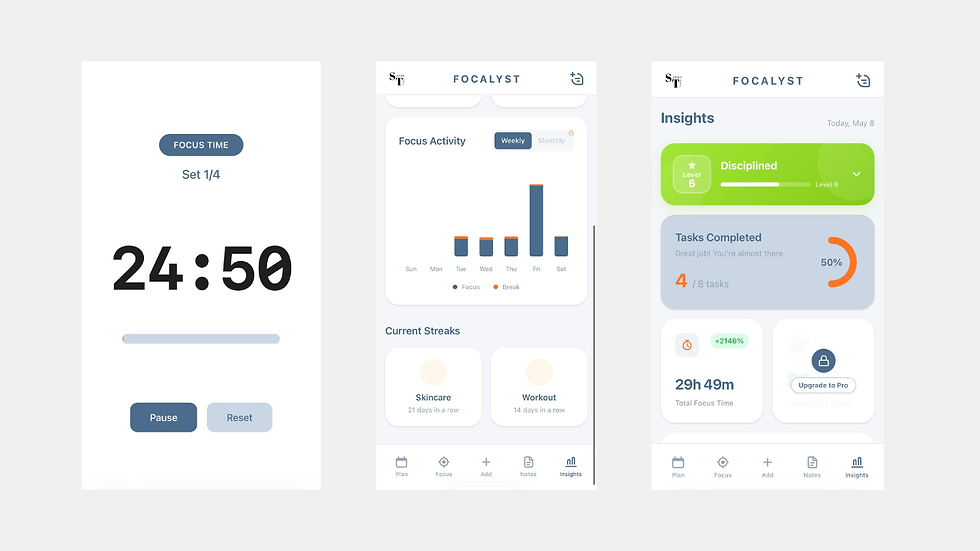
Using Focalyst’s Distraction-Free Pomodoro Timer for NEET 2026 preparation
Focalyst is an AI-powered productivity workspace designed to eliminate app-juggling and help students enter deep work faster.
For NEET droppers, the most valuable feature is the distraction-free Pomodoro timer.
Instead of managing:
Separate timers
Notes apps
Task trackers
Focus apps
You study inside one minimal workspace.
Benefits include:
Clean interface with minimal cognitive clutter
Long-focus Pomodoro cycles
Reduced attention fragmentation
Better consistency tracking
Faster transition into flow state
Example: A NEET dropper revising Human Physiology can run a 50-minute deep work block inside Focalyst without checking multiple apps every few minutes.
If you want alternatives, students also commonly use:
Google Calendar
Google Tasks
Notion
However, fragmented systems usually become difficult to maintain during intense preparation phases.
How Should NEET Droppers Revise Effectively?
Effective NEET revision is active, repetitive, and test-oriented.
Passive rereading creates familiarity, not mastery.
Use Active Recall
Active recall means forcing the brain to retrieve information without seeing the answer first.
Examples:
Solve Physics derivations from memory
Recall Biology diagrams mentally
Write reaction mechanisms without notes
This strengthens neural retrieval pathways significantly.
Use Spaced Repetition
Spaced repetition is the practice of revisiting information at increasing intervals.
A strong NEET revision cycle:
Day 1
Day 3
Day 7
Day 15
Day 30
This dramatically improves long-term retention.
Maintain an Error Notebook
An error notebook tracks repeated mistakes and conceptual weaknesses.
Top-performing droppers review mistakes more aggressively than successes.
Your weakest concepts should receive disproportionate attention.
What Should NEET Droppers Do Next?
The next step for NEET droppers is building systems immediately instead of waiting for motivation.
Start with:
A fixed wake-up time
Three deep work blocks daily
One revision cycle nightly
Weekly mock tests
A distraction-free study environment
Do not optimize endlessly.
Execution matters more than perfect planning.
A simple system repeated for 30 days beats complicated routines abandoned after two weeks.
Conclusion
The best 2026 study routine for NEET droppers is not the most extreme one. It is the one you can sustain consistently without destroying your focus or mental health.
Deep work, structured revision, distraction control, and realistic scheduling are what create rank-level performance over time.
Protect your attention aggressively. Your focus is your competitive advantage.
Written by Sohan Tamang, Founder of Focalyst and MBBS Student at IPGME&R and SSKM Hospital. Reviewed by Sohan Tamang.


Comments